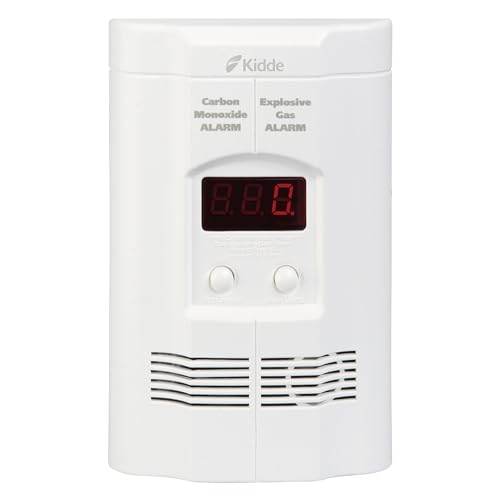
Kidde KN-COEG-3 gas and CO alarm
Pending verification Check price on Amazon (paid link)
Affiliate Disclosure: This page contains Amazon affiliate links. We earn a commission at no cost to you.
A gas leak detector is either an alarm you install and leave running or a sniffer you carry to find the leak. Which one you need, what each detects, and where to mount it for natural gas and for propane.
The 3 products: Kidde KN-COEG-3 gas and CO alarm · UEi CD100A handheld gas sniffer · Kidde plug-in CO and gas alarm, digital display
If you can smell gas right now, stop reading and act first. Leave the property, do not switch anything on or off, do not light a flame, and call your gas utility's emergency line or the fire service from outside. A detector is for the leaks you cannot smell; it is not the answer to one you already can. Our gas leak page covers what to do in order.
Two different products answer to the name, and buying the wrong one is the usual mistake:
If you want protection, buy the alarm. If you want to pinpoint a smell you noticed behind the stove, buy the sniffer. The two are not substitutes, and neither is a substitute for your gas utility when you can smell gas right now.
Where it goes matters as much as which one. Natural gas is lighter than air and collects high, propane is heavier and pools low, so the same alarm goes near the ceiling in a house on mains gas and near the floor in a house on propane. Mount it wrong and it will still be a working alarm that never smells anything.
First Alert GCO1CN and Kidde KN-COEG-3 are both AC plug-in alarms you install in your home and leave running. Each detects combustible gas (natural gas/methane and propane) and carbon monoxide in one unit, with a digital display and 9V battery backup. They are the right choice if what you want is ongoing, unattended protection in a fixed location: the kind of device you install once and forget about (aside from periodic testing).
The two are close alternatives from different brands rather than meaningfully different products: both are plug-in combo CO+gas alarms with a digital display, and both document the same mounting guidance (mount high for natural gas, which rises; mount low for propane, which sinks). Kidde's own documentation names a UL mark on its user guide's cover without spelling out the specific standard number in the guide's text; First Alert's spec sheet names "UL1484 and 2034" explicitly. That is a real, if minor, difference in how specific each manufacturer's own documentation is, not a claim that one device is more or less genuinely certified.
Read the full First Alert GCO1CN review for the sourced certification and specification detail behind that comparison.
UEi CD100A is not a fixed alarm at all. It's a handheld sniffer with an 18-inch flexible gooseneck probe, meant to be carried around and used to pinpoint exactly where a suspected leak is coming from (for example, checking fittings and connections near a stove or water heater). It does not detect carbon monoxide, has no digital display or continuous monitoring, and is powered by a 9V battery rated for about 5 hours of use. Its manufacturer describes it as a serviceman's tool for residential and small-commercial use, though it is worth knowing Amazon itself lists this product under an "Automotive Fuel Leak Detectors" category, not a home-safety one: a sign this tool sees professional and automotive use as much as household use.
Buy this if you specifically want to locate a leak you already suspect, not as a substitute for one of the fixed alarms above.
Kidde plug-in CO and explosive gas alarm. Detects carbon monoxide plus natural gas and propane in one unit, plugs into a socket, keeps a 9V battery as backup, and shows the current CO reading on a digital display. It is the same class of device as the KN-COEG-3 above and is the one to look at first if you are buying today rather than matching something already on the wall.
The same caveat applies as to every unit on this page: Kidde documents a UL mark on its user guide cover without naming the standard in the guide's text, and we have not checked it against UL's own records.
A carbon monoxide alarm on its own will not sound for a natural gas leak; it senses a different gas. Do carbon monoxide detectors detect natural gas? explains the difference and how to read the label on the alarm you already have.
Propane sinks, so every mounting instruction on this page inverts: the alarm goes near the floor, not near the ceiling. Propane leak detector: what to buy and where it goes covers that, plus where propane leaks usually start.
