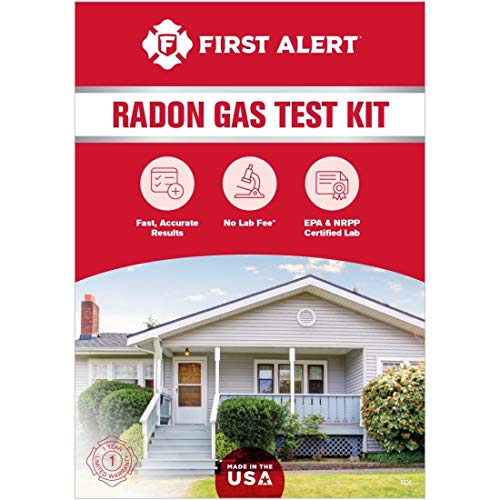
First Alert RD1 radon test kit
Pending verification Check price on Amazon (paid link)
Affiliate Disclosure: This page contains Amazon affiliate links. We earn a commission at no cost to you.
A radon monitor reads continuously and shows a number today; a short-term test kit goes to a lab and answers once. Which to buy, what the reading means, and when an alarm is the wrong tool.
The 2 products: First Alert RD1 radon test kit · Airthings Wave Radon monitor
"Radon detector" covers two products that answer different questions.
A word on the phrase "radon alarm": radon is not a gas you respond to in the moment the way you respond to carbon monoxide. There is no evacuation. A high reading is a reason to test properly and then plan mitigation, which is building work, not a reason to leave the house tonight. That difference is why the products here read and log rather than shriek. This collection also serves readers arriving from either the general radon-danger question or the continuous-monitoring problem page specifically: they are two related but distinct starting points, covered together here because the honest answer to "which should I buy" depends on comparing both.
The First Alert RD1 is a charcoal-canister kit: you expose it in your home for about 48 hours per the manufacturer's instructions, then mail it to a lab (the manufacturer names Alpha Energy Labs) for analysis. This is the standard first step for a household that has never tested, is buying or selling a home, or just wants a baseline reading before deciding whether further action or ongoing monitoring is worth it. One thing to know before buying: the manufacturer's marketing references an "EPA Radon Gas Measurement Proficiency Program" affiliation whose current status could not be confirmed against the current NRPP-accreditation ecosystem. This is not a confirmed or refuted fact, it is an open question, and it is not resolved by this collection page.
Read the full First Alert RD1 review for the complete sourced discussion of that open question.
The Airthings Wave Radon is a battery-powered device that stays in place and gives ongoing readings via a passive diffusion chamber and alpha-spectrometry sensor, synced to a phone app over Bluetooth. Per Airthings' own published specifications, its accuracy claim is explicitly time-dependent (within 10% after 7 days of continuous operation, tightening to within 5% after 2 months) rather than a single flat number. These are manufacturer-stated figures; Silent Home Hazards has not independently tested or confirmed them against a reference radon source. This is the right choice for someone who already has a baseline (often from a short-term test like the RD1) and wants ongoing trend data instead of a single result.
Read the full Airthings Wave Radon review for the complete specification and sourcing detail.
Neither type is a universally better choice. They answer different questions, and many households reasonably use a short-term test first and add continuous monitoring later.
