Kidde Nighthawk KN-COEG-3 CO and Explosive Gas Alarm Review
Affiliate Disclosure: This page contains Amazon affiliate links. We earn a commission at no cost to you.
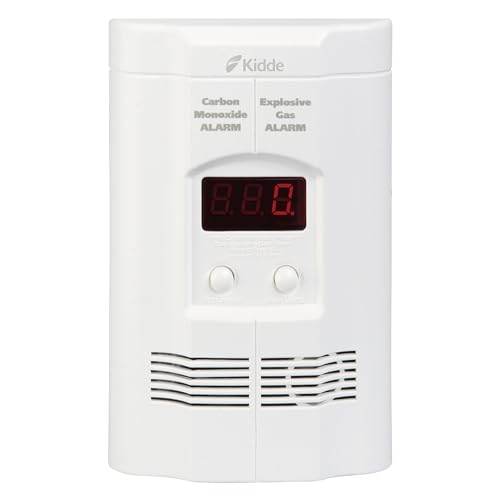
Kidde KN-COEG-3 gas and CO alarm
Recommended With Caveats Pending verificationKidde's own manual shows a UL 'listed' mark but does not name the specific standard number the way the First Alert GCO1CN's spec sheet does. Both remain unconfirmed manufacturer claims.
Check price on Amazon (paid link)Quick answer
The Kidde KN-COEG-3 is a plug-in alarm that detects both carbon monoxide and combustible gas (propane, natural gas, and methane) in one unit with a digital display, the direct Kidde-brand equivalent of the First Alert GCO1CN reviewed elsewhere on this site. Its official user guide shows a UL "SIGNALING LISTED" mark on the cover, but, unlike the GCO1CN's own spec sheet, doesn't spell out the specific UL standard number anywhere in the document's 23 pages, a real, documented difference in claim specificity between the two.
Is this the Kidde Nighthawk?
Yes, with a wrinkle. Kidde's own store sells this model as the "KN-COEG-3 Nighthawk Plug-In Carbon Monoxide and Explosive Gas Alarm with Battery Backup". Kidde's main product page for the same model number does not use the word at all and calls it an "AC Plug-in Operated Carbon Monoxide and Explosive Gas Alarm with Digital Display". Both pages were read on 1 October 2026.
So "Nighthawk" is a name Kidde attaches to this unit in some places and drops in others. If you are replacing an older alarm with Nighthawk on the front, match the model number printed on the back of your unit instead of the name.
Sources: Kidde store listing, Kidde product page.
What it does
Per Kidde's official user guide, the KN-COEG-3 combines an electrochemical CO sensor with a metal-oxide combustible-gas sensor in one 120V AC plug-in unit with a 9V battery backup, and shows readings on a digital display. Kidde's own manual gives the same kind of mounting guidance already documented for the First Alert GCO1CN on this site: natural gas is lighter than air and rises, so the unit should be mounted high (no closer than 6 inches from the ceiling); propane is heavier than air and sinks, so it should be mounted near the floor. The manual also gives a specific, tiered CO alarm response schedule tied to concentration.
Key specifications
According to Kidde's official user guide (P/N 820-1557 Rev. E) for this model:
- Sensors: Electrochemical (CO) + metal oxide (combustible gas: propane, natural gas, methane)
- Power: 120V AC plug-in with 9V battery backup
- Audible alarm: Manufacturer-rated at 85+ dB at 10 feet
- CO alarm response times (per the manual's own schedule): 70 ppm sustained = 60 to 240 minutes; 150 ppm sustained = 10 to 50 minutes; 400 ppm sustained = 4 to 15 minutes
- Gas alarm threshold: Alarms before reaching 25% of the Lower Explosion Limit (LEL) for the detected gas
- Mounting guidance: High (6"+ from ceiling) for natural gas/methane; low, near the floor, for propane
- Display: Digital, with peak-level memory
What we like
- A real, tiered CO response schedule stated in the manual, not just a single alarm threshold: the same level of documented detail found on this site's other Kidde and First Alert CO/gas reviews.
- Direct Kidde-brand alternative to the First Alert GCO1CN, useful for anyone who wants brand diversity or already owns other Kidde alarms.
- Mounting guidance matches the documented physics exactly (gas density determines mount height), consistent with, not contradicting, the equivalent guidance already published on this site's GCO1CN review.
Limitations
- The UL mark on the manual's cover doesn't name a specific standard number. See "Safety and certification" below. This is the single clearest difference from the GCO1CN, whose own spec sheet explicitly names UL 1484 and UL 2034.
- AC-outlet dependent, with only a 9V battery as backup power, the same constraint as the GCO1CN and the Kidde KN-COP-DP-10YH reviewed elsewhere on this site.
- No interconnect capability found in the user guide reviewed.
Who should choose it
- A household that wants combined CO and combustible-gas detection in one plug-in unit and prefers the Kidde brand or already owns other Kidde alarms.
- Anyone who wants the same tiered CO-response documentation found on this site's other reviewed alarms.
Who should skip it
- Anyone for whom a specifically-named UL standard citation matters. See the First Alert GCO1CN reviewed elsewhere on this site, whose own spec sheet names UL 1484 and UL 2034 directly.
- Anyone who needs battery-only placement flexibility. This unit requires AC power, with battery only as backup.
Safety and certification
What Kidde states: the official 23-page user guide's cover carries a UL "SIGNALING LISTED" mark. The same document gives a full, specific spec table (sensor types, alarm decibel rating, the tiered CO response-time schedule, and the 25%-LEL gas alarm threshold) but at no point in the document's text does it spell out a specific UL standard number (such as "UL 2034") the way the GCO1CN's own spec sheet does on this site.
What that is not: this is not an independent confirmation by Silent Home Hazards against UL's own certification database, and the specific-standard-number gap noted above is a real, documented difference in how this manufacturer's own materials present the claim compared to a sibling product reviewed on this site, not a judgment that the underlying certification doesn't exist, only that this specific document doesn't name it. Either way, this site treats the claim as unconfirmed.
Sources
- Kidde's current manufacturer product page. Supports: model identity, power source, digital display, peak-level memory; states no certification claim on this page specifically.
- Kidde official User Guide, P/N 820-1557 Rev. E (manufacturer, full 23-page PDF manual). Supports: the UL "SIGNALING LISTED" cover mark, the full sensor/alarm spec table, the tiered CO alarm response-time schedule, the 25%-LEL gas alarm threshold, and the mounting guidance. The copy of this manual found during research is hosted on Amazon's own media CDN rather than a manufacturer domain, so it isn't linked here (this site's content never hardcodes an Amazon-domain URL, including Amazon-hosted files).
- Amazon's product listing for this ASIN: identity/availability context only, not used for any specification or safety claim; the affiliate link below is generated automatically, not hand-typed (this site's content never hardcodes a second Amazon URL alongside it).
No customer review text, star rating, or Amazon-listing safety claim was used as a source for any statement in this review.
About this review
Silent Home Hazards has not tested this device firsthand. We have not installed, alarmed, or measured this unit ourselves. Every specification and claim above is drawn from Kidde's own published materials, cited above, and is written as a sourced claim rather than a first-hand finding.